Is our democracy in danger? The logjam and paralysis in every sessions of the Parliament drive everybody to despair and cynicism. The claim of India being the mother of democracy, however, does not match with a non-functioning Parliament and public apathy about it. Actually, a nonfu ncti oning Parliame nt portends the collapse of Parliamentary democracy. The accountability of the executive is the essence of the Parliamentary democracy. It is this accountability that goes when the parliamentary system collapses.But when no serious debate is allowed on important issues or when bills are passed without discussion or Finance Bill is passed in 15 minutes, the accountability of the executive and the ruling Party ceases to operate. Such di sregard to the parliame ntary process and ruling party attitude of opposition-mukht India h as really weakened the Parliament. The number hour parliament sits itself indicates the declining tre nd of its incre asing irrelevance, leave alone its debates and efficacy of parliamentary committe e’s scrutiny of Bills.
According to the PRS Legislative Research data, the number of sitting days in the Lok Sabha reduced from an annual average of 121 days during 1952-70 to only 56 days in 2022. The declin e is also evident from the astonishing speed in passing legislation. The Lok Sabha, on average, took less than 10 minutes to pass a law, and the Rajya Sabha less than half an hour in 2020. In September 2020, two important sets of laws – the farm laws and the labour codes – were passe d without discussion despite protests by the opposition and the required voting procedure, as specified by the parliament’s own rules, had not been followed in the Rajya Sabha.
Among the other indicators of decline are the shrinking space for the opposition, an increasing recourse to ordinances which circumvents parliament, and the bypassing of the parliament on several important initiatives.
Bills have been passed in the midst of din and noise with no consideration for opposition concerns or protests. Even worse, some important bills have been passed by vo ice vote, and sometimes without a single MP speaking, other than the minister in charge of the bill.
In addition to this, there is a significant decrease in the involvement of standing committe es – the de liberative core of parliamentary work in legislative matters. The perce ntage of bills re fe rred to parliamentary committees has drastically reduced from 71% in the 15th Lok Sabha (2009-14) to 27% in the 16th Lok Sabha (2014-19), and to only around 13% since 2019. Even the bill revoking Article 370 and creating two Union territories out of the state of Jammu and Kashmir did not go through a parliamentary committee (leave alone consulting the elected government).
Passing bills without debate or scrutiny reduces parliament to a clearance window for legislation. This effectively means parliamen t was ne ither ful fillin g its function of deliberative law-making body nor of holding the executive accountable. This is a cle ar sign that India’s parliamen tary democracy has incontrovertibly changed with the rise of majoritarianism.
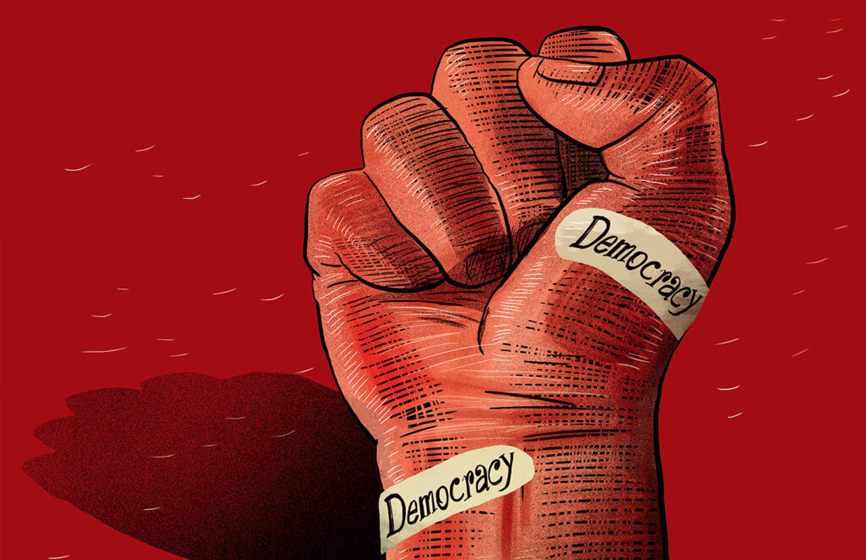
What resonated through the entire budget session was the government’s refusal to concede to the opposition’s demand for an investigation by a Joint Parliamentary Committee (JPC) into Hinde nburg Research’s report alleging Adani Group’s manipulation of the stock market and public policies. Around Rs.45 lakh crore budget was passed without debate.
In the current monsoon session some important legislations we repassed without the presence of opposition parties in the house.Accordingly, 14 Bills were passed in 22 hours of discussions, with five hours accounted for the contentious Delhi Services Bill. Some Bills were passed after just minutes of debate or even without.Among the Bills so passed, besides Delhi Bill, there are some bills like Mines and Minerals (Development and Regulation) Amendment Bill, The Offshore Areas Minerals (Development and Regulation) Amendment Bill and the Forest Conservation Amendment Bill and soon and so forth which are nothing but open sell – out of national natural resources to corporate cronies.
Now, India, the leading largest democracy had slipped 10 positions to 51 in the Democracy Index. India has now been ranked 108th spot in the global Electoral Democracy Index, far behind nations like Tanzania, Bolivia, Mexico, Singapore and even Nigeria which in a modest 91st spot by V-Dem Institutein its Electoral Democracy Report for 2023.
Thus there is a palpable sense of fear that the foundation of our country’s republican democracy is under severe threat – from the ruling party itself. In the past nearly nine years, the Narendra Modi led BJP government has systematically subverted the Constitution and its many pillars, be it the Supreme Court, the Parliament, the democratice lection and governance system, the role of various watchdogs like the CBI or the CVC, the Reserve Bank of India.
But what are reasons behind this? Of cou rs e , it is true that BJP draw s i ts ideological sustenance from the RSS- the most reactionary ultra-right organisation, and today, most of the top government positions starting from the Prime Minister are held by RSS leaders. And the RSS openly strives for a Hindu Rashtra which it wants to establish on the ruins of the present Constitutional democracy.It is worth while to recall that just after Independence, the ‘Organiser’ – the mouth piece of RSS demanded that instead of the Constitution, the Manumsriti be enacted as the law of the land (see Organiser dated 30th November, 1949 and 25th January 1950). Manusmriti is a treatises aid to be written by the sage Manu codifying the chaturvarnashram system- which laid the foundation for institutionalization of caste oppression and barbarity.
Why because, the Preamble of Constitution of India declares India as a sovereign,socialist, secular democratic Republic.In fact, the words ‘socialist’ and ‘secular’were added to it through 42nd Constitutional Amendments in 1976. This later addition of these words has also heavily been abused by Hindutva fringe elements as that Constitution was not secular in its origin. Though the word ‘secular’ was not used in the Preamble when the Constituent Assembly adopted it, but the content, the vision, the approach and the tenor of the Constitution are secular. It is not a small thing but it was a great beginning in the life of India as nation state.It signifies a total break in the hundreds of years of an abhorrent tradition which divided our people on the basis of birth and made them to believe that men are not equal. This tradition, which is called Sanatana Dharma tradition, created in India the worst kind of oppressive, inequitable and unjust society where a large got its ideological in spiration from this abhorrent Manuvaditradition.
The idea of justice, liberty, and equality were alien to this society. The division of the society in to four water tight compartments with no upward social mobility was sought to be sanctioned by divinity and regulated by the Dharma Sastras which were the laws of ancient India. Thus, India was shaped as a country in which God himself proclaims that Man is not equal and the laws which emanated from the scripture sperpetuated an unequal, unjust and extremely oppressive social structure. It was the Constitution which gave the people of India ideas of equality, liberty, fraternity and justice, and created the necessary institutional structures for ensuring that the people enjoyed those benefits. So, the historical significance of the Constitution is that it ushered the country into the modern world, and sought to make a complete break with the abominable traditions which enslaved the mind of people in this sub-continent for almost three millennia.
The Parliamentary democratic governance system which the Constitution envisaged for free India is not an accident of history. But it was germinated and took concrete shape during our long protracted united struggle for independence by our people with be wildering diversity in terms of different religious faith systems, customs, way of living, language, etc. This glorious freedom movement during its bitter fighting with colonial masters had also intensely debated about the form of government best suited to free India. There was a consensus the non the parliamentary system with cabinet form of government. It was then thought that this form of government which will be collectively responsible to a parliament representing the people who are sovereign would be the most appropriate for the country.
The viability of such democracy requires a belief among the people that they can make a difference to the irlives by participating in the democratic process. This believe may be a false one; it may be a mere illusion. But unless this illusion exists, people become not just cynical about the democratic process but despondent about their capacity to make any difference to their lives through their own efforts. Such despondency then leads to quest for a “messiah” or “savour” like Modi supposedly end owed with extraordinary powers who came come to their rescue. They no longer remain “on the side of reason” but start moving into a realm of irrationalism as we witness in India today.
In the period of the hegemony of monopoly capital, such “saviours” and “messiahs” are typically either manufactured or propped up or, even those i nstance s where they make the initial headway on their own, appropriated, by the corporatefinancial elite, which uses for this purpose the media under its control as the irrule becomes synonymous with corporate rule. And this constitutes the core of fascism. It may be recalled that Mussolini had written: “Fascism should more appropriate be called corporatism be cause it is a merger of state and corporate power”. Thus the loss of belief among the people about the possibility of themselves making a difference to their own lives through democratic political intervention and the overwhelming prese nce of a corporate state which engulfs all realms of human life create the condition for fascism.
In the era of “neoliberal globalisation”, not only is there a similar loss of belief among the people about the possibility of their achieving any change through political intervention via the available formal democratic channels, but this loss of belief is reflective of a reality embedded within the system itself. In the words of Prof. Prabh at Patnaik “the tendency under neo-liberalism, in other words, is to produce a conjuncture characterised by this loss of belief in the efficacy of democratic institutions among the people, a conjuncture that is conducive therefore to the growth of irrationalism and fascism”.
He pu ts the matte r diffe re nt l y, Ne oliberalism tends to produce a “closure” in the realm of politics, where the political choices available to the people are all characterised by identical economic policies, because of which little difference is made to the material condition of the people by the political choice they exercise. It’s a cul-de-sac situation for the mass.
Globalization entails the free movement of goods and services across countries, and above all of capital including the form of finance. Since capital becomes globalized in this era while states continue to remain nation states, policy everywhere must be such as to retain the “confidence of the investors”, ie, to cater to the caprices of globalized capital, for otherwise capital would leave enmasse the shores of the country in question, precipitating for it an acute crisis. The desire to prevent such a crisis forces all political formations within the country, as long as they visualize their country remaining with in the frame work of globalization to adopt agendas that globalized capital would accept. This, therefore, effectively denies any political choice to the people. No matter whom they elect, no matter which particular government comes into being as a result of the choice they exercise, it willy-nilly a do p t s t he s ame set of “neo-liberal ” policies.And this is the obvious subversion of d emocracy and globalised finance capital entailed in the system. Neo – liberalism has to dismantle all democratic form for its survival from the current stage of systemic crisis.
Indeed, it’s this very threat to democracy that is the ke y to unde rstanding neoliberalism’s resilience: its capacity to endure crises and rival systems is not so much a consequence of the enduring appeal of free markets and eco nomic competition. Instead, neoliberalism has survived by altering the very foundations of our democratic institutions and organizations.
In doing so, neoliberalism has allied with forces — dictators and technocrats — equally contemptuous to democracy. This core aspect of the neoliberal project is what is setting the stage for a new breed of radical right leaders across the globe. Today, there is an eme rging alliance between neoliberals and big capital drawing on the support of so called nationalists, social conservatives, and authoritarian populists like Modi. It is this alliance that may well pose one of the greatest threats to democratic politics.
Neoliberals have insulated policymakers from any constitutional commitments.For instance, independent central banks and fiscal policy rules are key instruments in keeping monetary and fiscal policy away from democratic deliberation. Fiscal rules like balanced-budget procedures severely reduced government’s overall spending capacity. In addition, the establishment of high constitutional thresholds to change these arrangements locked key aspects of elected government’s economic policy toolkit out of their reach. Considering neoliberalism’s hostile relation to basic democratic institutions, it is not hard to understand the elective affinity between neoliberalism and today’s radical populist right. The radical right is not emerging “from the ruins” of neoliberalism but from the concrete possibilities that arise when the core te nets of neoliberalism are “hybridized” with right wing populism.
How did this hybrid emerge? In the 1970s to ’80s, ne olibe ral ide als had formed clandestine nexus with authoritarian doctrines to cre ate some of the most swe eping re forms — and rules of dictatorships — the world had ever seen. Similarly, today, the core principles of neoliberalism are prone to form alliances with the radical populist right.
These alliances are not based on a shared interest in market freedoms but on a common contempt for democratic politics and the perceived need to further limit representative democratic institutions. Hence, despite claims that populism and neoliberalism are antagonistic tendencies, the right wing populist like Modi attempts to hamper basic democratic liberties and institution s actually re inforce neoliberalism’s anti-democratic project.
Almost everywhere, neoliberalism has been associate d wi th e nhance d executive authority and the delegation of democratic power to unaccountable bureaucratic institution s. O ften, neolibe rals have altered electoral systems and patterns of political representation to favor “economic liberty,” similar to how the radical populist right like BJP undermines democracy today.
Then what is urgently required now is not getting hegemonised by the logicof neoliberalism. Preventing and Resistingthe onslaught of neo-liberal and neo-fascistic alliance against democracy is conditioned by the whole-some rejection of neo-liberal hegemony and taking conscious efforts for a counter-hegemony led by the working classagainst neo-liberal order. That is the only way to protect democracy which presupposes for the existence of any democratic movements in the country including trade union movements. (Author is National Secretary,CITU)