


THE elections to Greek parliament were held in two phases. As the first phase held in May proved to be inconclusive, a second phase was held on 25 June 2023, which resul te d in the fo rmation of the government by the Conservative, New Democracy. According to Greek laws, if no party is able to form a government after an election, a snap poll would be called and the party securing highest vote share in that snap poll would be awarded ‘bonus seats’, which are decided in the following manner: The party coming first with at least 25 percent of the votes would receive 20 extra seats, with one more seat for every half percentage point above 25 percent, to a maximum of 50 extra seats at 40 percent (or more) of the votes. This law enacted in 2020 came into effect in this election, as no party could form a government in the May elections.
In the June e le ctions, the conservative party, New Democracy (ND) got 40.55 pe rce nt, SYRIZA got 17.84 perce nt, and the other older social democratic party, PASOK got 11.85 percent. The Communist Party of Greece (KKE) got 7.7 percent votes.
The voting percent in June dipped by nearly 7 percent points than that was registered in the May elections. One of the most important re asons was the disillusionment of a majority of the people with the major political forces that made them skip voting. An analysis made after the polls showed that most of the voters who did not participate in the June e le ctions belonge d to the two major political parties – the ND and PASOK. The voters of SYRIZA too did not come to vote in the June leg. In spite of the ND voters not coming out to vote, it could muster a majority because of the 50 bonus seats it gained.
A heartening feature in the election was the consistent rise in the vote share of the KKE. The KKE saw a 2.5 percent increase in its vote share compared to the e le ctions held in 2019. Even whe n compared to the votes it had secured in May, it witnesse d an increase o f 0.4 perce nt. The in creasing vote share naturally led to an increase in the number of KKE members in parliament. It has now 21 MPs. It could not get 5 more seats because of the bonus seats legislation, which were cut from it and given to the ND.
In an atmosphere whe re it is alway s pointed out that the Left, particularly the Communist Parties are losing badly in elections, the gains secured by the KKE stand out. This is all the more significant as it is happening in continental Europe. Interestingly, it should be noted that the media favourite, ‘Left’ party SYRIZA, is consistently losing support due to the compromises it had made with neoliberal policies and the austerity measures it had enforced at the behest of international finance capital.
A major reason that contributed to the increasing support for the KKE is its consistent struggles against the economic policie s implemen te d by succe ssive governments in Gree ce . Th e KKE le d uncompromising struggles against the governments of ND, PASOK and even SYRIZA. If we count from the recent past, since the onset of the global economic crisis in 2008, every year, KKE stood along with the working class confederation PAME in ensuring that all working class struggles are well participated. On an average during this period, at least three general strikes were held every year, apart from many sectoral strikes. The KKE was actively engaged in the campaigns and ensured that its cadre actively participated at the pickets.
The KKE notes that this electoral rise is also because of its ‘ideological-political interve ntio n’ on al l important issue s concerning ‘history, economy, advances in science, technology, education and health’. It actively intervened in all contemporary social issues and in the field of culture, which has enabled the rallying of broader forces. One instance is the increasing participation of pe ople in the annual cultural festival – Odigitis organised by the Communist Youth of Greece (KNE). The KKE firmly stood in defence of socialism. Socialism is championed as the only way out for the working class and the people of the country.
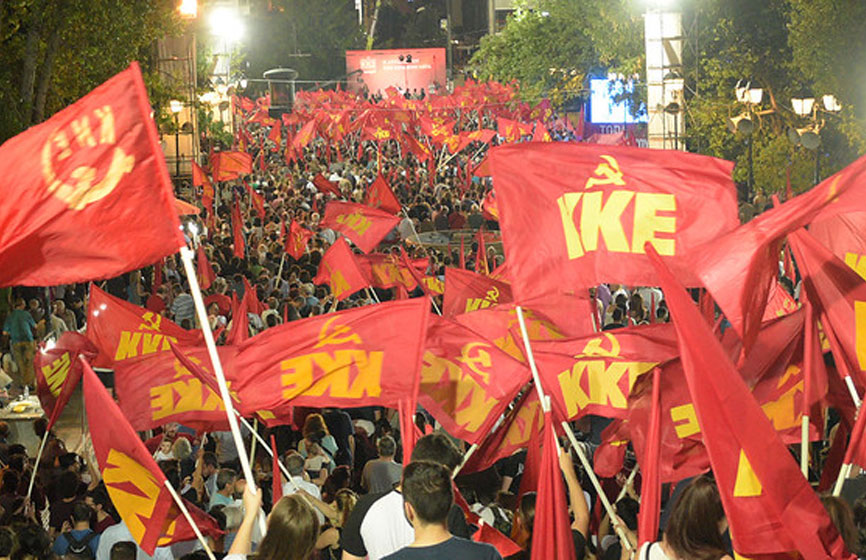
KKE maintained its militant ties in the workplaces, neighbourhoods, villages, health care ce ntre s, educational institutions and in the arena of culture. The y jo ined force s with hundre ds of workers and breadwinners against the foreclosures of houses and small shops, in the demonstrations against workplace accidents. The KKE led demonstrations condemn ing the attitude against the migrants, particularly the policies that resulted in the death of hundreds off its coast. They stoo d alo ng with the demonstrations of farmers to defend their income and livelihood. The intervention of KKE in the health sector, particularly during the pandemic, when hundreds of KKE volunteers provided care and also fought for the rights of the health care workers, won laurels. Because of these efforts, the trade unions in health sector moved closer to the KKE.
Members and cadres of KKE were active during natural disasters like forest fires and storms, while the government had abandoned people. It played an active role in the organisation of self-employed and led their struggles. The KNE was actively engaged in taking up the issues of students and youth. As a result of its activities among university and school students, its’ student-wing Panspoudastiki stood first in the stude nt elections fo r the second consecutive year. An example of the nature of the work done by the KKE among these sections can be un de rsto od by its intervention during the horrific train crash in Tempe, where many students and people lost their lives. The KKE squarely blamed the policy of privatisation and liberalisation of transport as the reason for the accident and mobilise d pe ople against the government. It presented before the people its perception of ‘workers’ power and governance, its character, the conditions for its realisation’ and the role that the KKE will play in it.
The MPs of KKE were active in the parliament forcing the government to discuss working class issues and their struggles. The KKE states that it had ‘used the parliament to expose the class politics of the government and other parties’. As a re su lt o f all the se militant and consistent political interventions, KKE was able to gain substantially in working class neighbourhoods. It gained in the workingclass and popular districts of Athens, Piraeus, Thessaloniki and other large cities.
An analysis of the voting pattern shows that 7.9 percent of men and 7 percent of women voted for the KKE. It’s share among young people aged 17-24 years is 8.1 percent, that is, above the Party’s average percentage. The Party’s share among those aged 25-34 years is 8.9 percent; among 35-54 years is 7.5 percent and among 55 and above is 7.1 percent. This shows that KKE received most of its votes from the youth. If we look at voters by occupation, we would find that 9.5 percent of university and school students; 9 percent private sector employees; 8.7 percent unemployed; 8.5 percent of the public sector employees; 7 percent of housewives; 6.2 percent of the self-employed; 5.7 percent of pensioners and 5.2 percent of farmers, live stock farmers and fishermen voted for the Party. This shows that majority of the support for the KKE comes from the working class and the farmers.
The KKE believes that this victory will enable it to further ‘regroup and give a massive character to the workers-people’s unions and organisations, as we ll as change the correlation of forces’. The KKE thinks that the correlatio n of force s remains ‘negative’ mainly because ‘the parties that support the policies of the business gro ups, the EU and NATO continue enjoying the vast majority of the workers’ and people’s support’. It notes that this is not because of their acceptance of the anti-popular policies of the ruling class parties. According to the KKE, majority of the workers are being cheated by the ruling class propaganda. Hence it is upon the KKE to carry out an intense ideological campaign exposing the class character of the government and mobilise people in the struggle against capitalism.
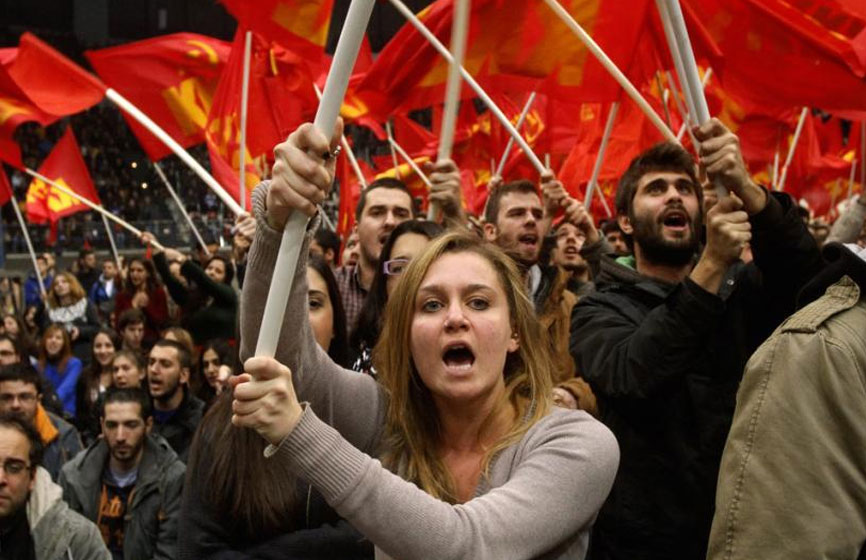
The KKE also noted the enhanced presence of far-right parties in Parliament and state d that th ere is no room for complacency in the fight against them. The roots of these far-right forces lie in the present capitalist system, the EU policy on immigration, the policy of repression and offensive against the workers’-people’s movement. The KKE states that these forces ‘cannot be dealt with by some legislative measures’. “This is a matter for the workers’-people’s movement. The KKE will continue to struggle in this direction, as it has done so throughout the previous period”.
The ND government has already expressed its intention to expedite its anti-popular agenda and made new commitments to EU and NATO. It intends to adopt anti-labour and anti-popular measures, entailing a new round of heavy taxation on the working class and the self-employed. So the KKE cautioned people that difficult times lie ahead, it called upon the people not to adopt a ‘wait-and-see stance or give a grace period’.
The KKE went to these elections with the slogan: ‘100 percent militant, worki ng-class, people’s o ppositio n’. Immediately after the election results it promised that it would put into practice its commitment to be at the fo refront of militant struggles. KKE states that will strive to retain its militant connections with the working class and intervene in all its struggles. KKE is confident that today it is in a more capable position to convince the youth and workers and rally them under its banner.
(Author is General Secretary, AIPSO)

